



Studio Sifaka, launched in 2019 by Fondation Hirondelle with the support of the United Nations Peace Building Fund, is a radio and web production studio aimed at Malagasy youth. In July 2021, it became an independent NGO. Studio Sifaka continues its commitment to improving access to information and amplifying the voices and concerns of young Malagasy people. Since then, Fondation Hirondelle and the Studio have maintained a close partnership through technical, editorial and financial support.

Studio Sifaka’s mission is to provide reliable, accessible and useful information to young Malagasy women and men on issues such as employment, education and training, health, the environment, as well as entrepreneurship and innovation driven by the private sector and civil society.
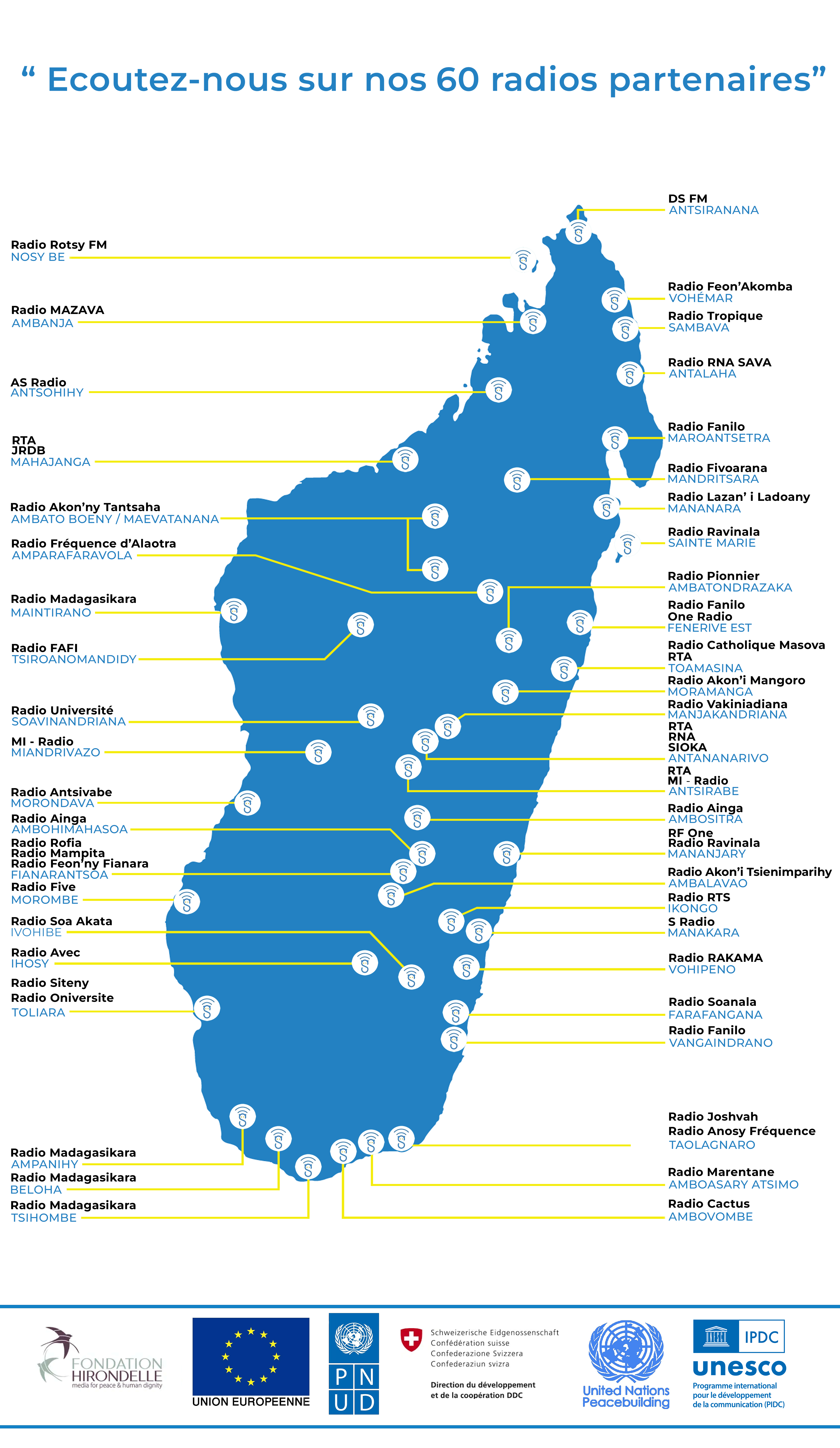
To this end, a daily two-hour programme, broadcast in Malagasy and French, offers national and regional news bulletins, thematic magazines, debates and cultural content. It represents a unique offering in Madagascar, relayed by a network of 60 partner radio stations across the entire island.
Financial Volume 2025
178’883 CHF
Sources of funding
- Switzerland (SDC core contribution)
- FEDEVACO
- Fondation Aide à l’enfance et au Tiers-monde
Key figures for 2025
60 partner radio stations
97 people trained
16 listener clubs, 160 members
108’400 followers
on social media
2 broadcast languages
700 hours of broadcasting per year
Context
In 2025, Madagascar experienced a period of political instability marked by nationwide protests linked to deteriorating living conditions, water and electricity outages, and political tensions. These mobilisations led to the fall of President Andry Rajoelina in October and the establishment of a military transition led by Colonel Michael Randrianirina.
The protest movement, particularly in the capital, was largely driven by an urban and connected youth, mobilised to demand greater transparency, increased citizen participation, and better living conditions. In this context, the spread of misinformation and rumours on social media intensified, reinforcing the need for reliable and accessible information.
Promoting youth voices for an inclusive and democratic society
Studio Sifaka continued its work of informing and fostering dialogue for Malagasy youth in a particularly unstable political context. The studio ensured regular and balanced coverage of protests and political developments, both on the radio and across digital platforms and social media, enabling its audience to follow events in real time.
Facing the spread of rumours and misinformation during the crisis, the team strengthened its fact-checking activities, with near-daily monitoring of content circulated online. These efforts helped clarify certain rumours and foster a more informed public debate.
Studio Sifaka also continued its editorial and training activities, particularly in the field of public health with the programme Santé Naka, which offers shows dedicated to health issues. Training sessions and workshops bringing together journalists, health professionals and civil society organisations helped strengthen coverage and foster dialogue between media, local stakeholders and authorities.
Finally, the studio continued to support youth expression through editorial formats and public events, including debates bringing together young people, transitional authorities and civil society stakeholders.
Priorities
- Inclusion of Malagasy youth
- Participation in democratic processes
Activities
- Daily production of 2 hours of programmes on topics of interest to young people
In 2026, Studio Sifaka aims to strengthen its role as a provider of information and dialogue for Malagasy youth, in a still uncertain political and institutional context. The transition initiated following the events of October 2025 opens a period of political reconfiguration, in which access to reliable and independent information remains essential to enable citizens—particularly young people—to understand the issues at stake and participate in public debate.
The studio will continue the daily production of its programmes, while seeking to further develop its formats and content, both on the radio and on digital platforms, in order to reach more connected audiences.
Building on the experiences gained in 2025, it will strengthen its editorial presence online and the dissemination of verified information. In response to the spread of rumours and misinformation, it will maintain its fact-checking activities and efforts to raise awareness about disinformation.
The studio will continue its engagement in the field of health through the programme “Informing for Better Health”, supported by FEDEVACO and private foundations. It is notably based on the Santé Naka programme, as well as on training sessions and exchanges between journalists, health professionals and civil society organisations. These activities contribute to improving coverage of health issues, both within Studio Sifaka and among trained partner radio stations, and to strengthening dialogue between media, local stakeholders and health authorities.
Finally, Studio Sifaka aims to strengthen its role as a platform for dialogue between young people, transitional authorities and civil society organisations. Youth mobilisation, particularly among urban and connected generations, played a central role in the protests that led to the change in power. However, some of these young people now feel excluded from the political process led by the authorities. In this context, the studio will seek to develop public debates and participatory initiatives in different regions of the country, enabling young people to voice their concerns and contribute to discussions on the country’s future.
Our impact
Studio Sifaka’s content helped young people better understand political issues and developments. During the 2025 Fall crisis, some publications reached several thousand views and generated strong engagement. They confirmed young people’s interest in reliable and contextualised information that reflects their concerns.
Testimonial
“Before, we didn’t know that children should not be married before reaching adulthood, that early pregnancies should also be avoided, and that for this, information on contraceptive methods can be obtained at the hospital.”
A resident of Sihanomaro, in the Ambovombe district, where Sifaka set up a listening point at the beginning of the year.